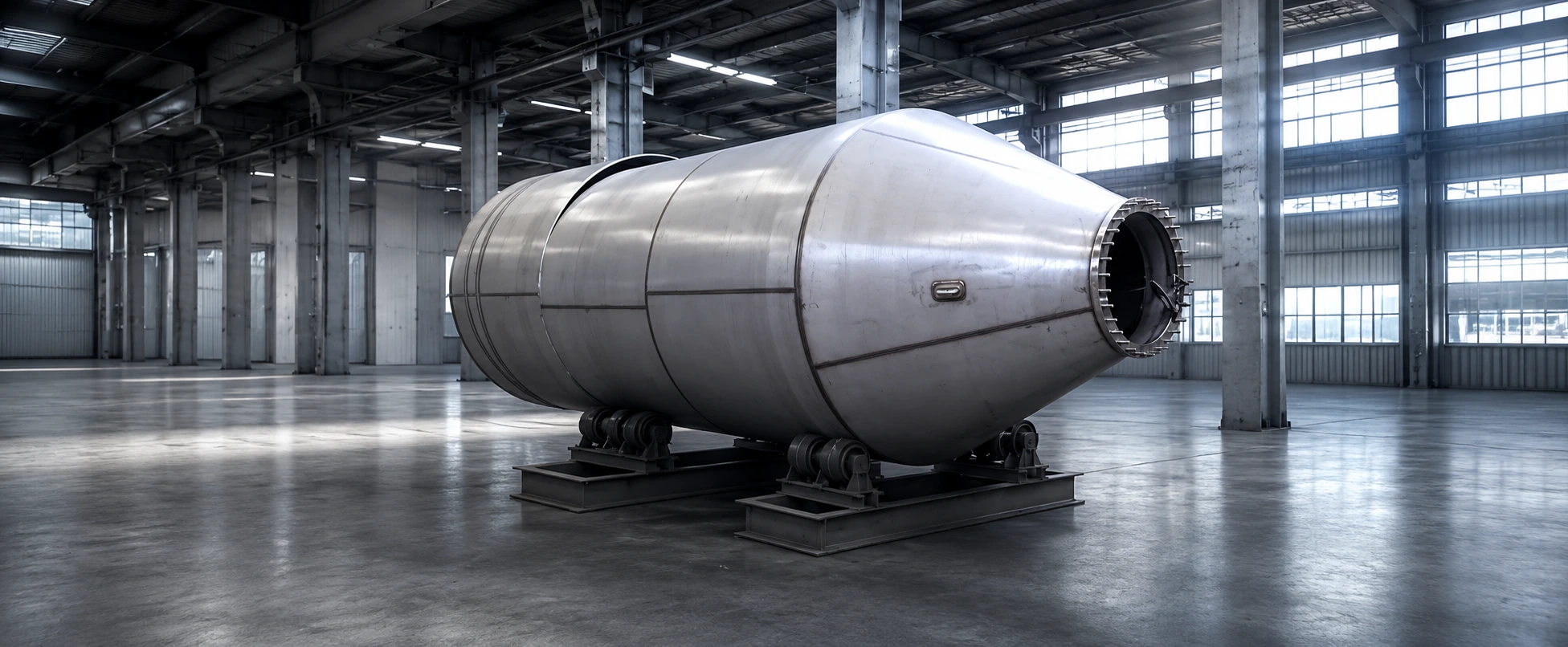
Pulsed gas-jet mixing technology with no moving parts inside the vessel — fast and gentle mixing and homogenizing of free-flowing bulk solids.
A discontinuous pneumatic mixing system: high-velocity gas jets are injected into the product at a defined angle, abruptly gyrating the entire batch. Suitable for all free-flowing bulk solids.
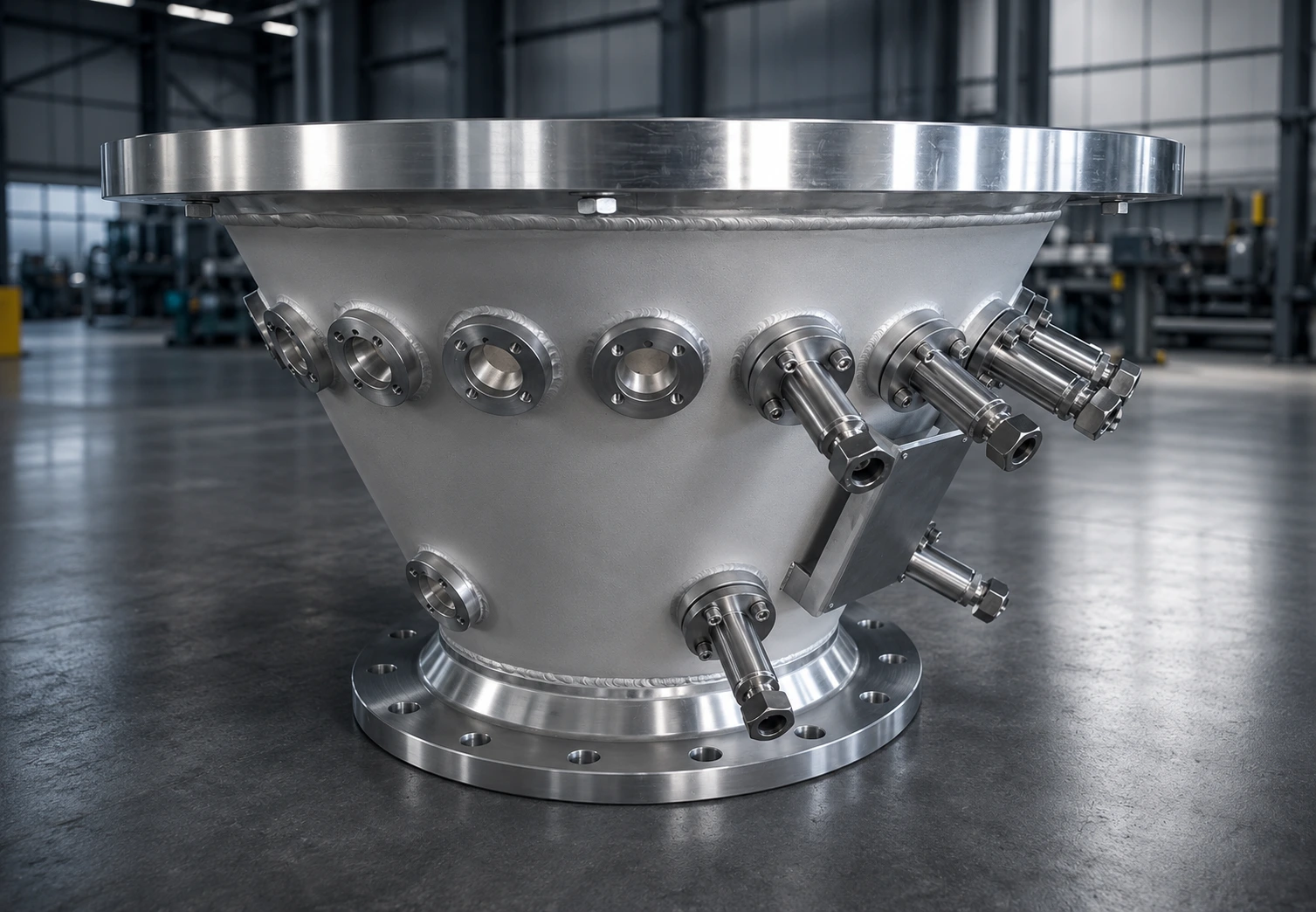
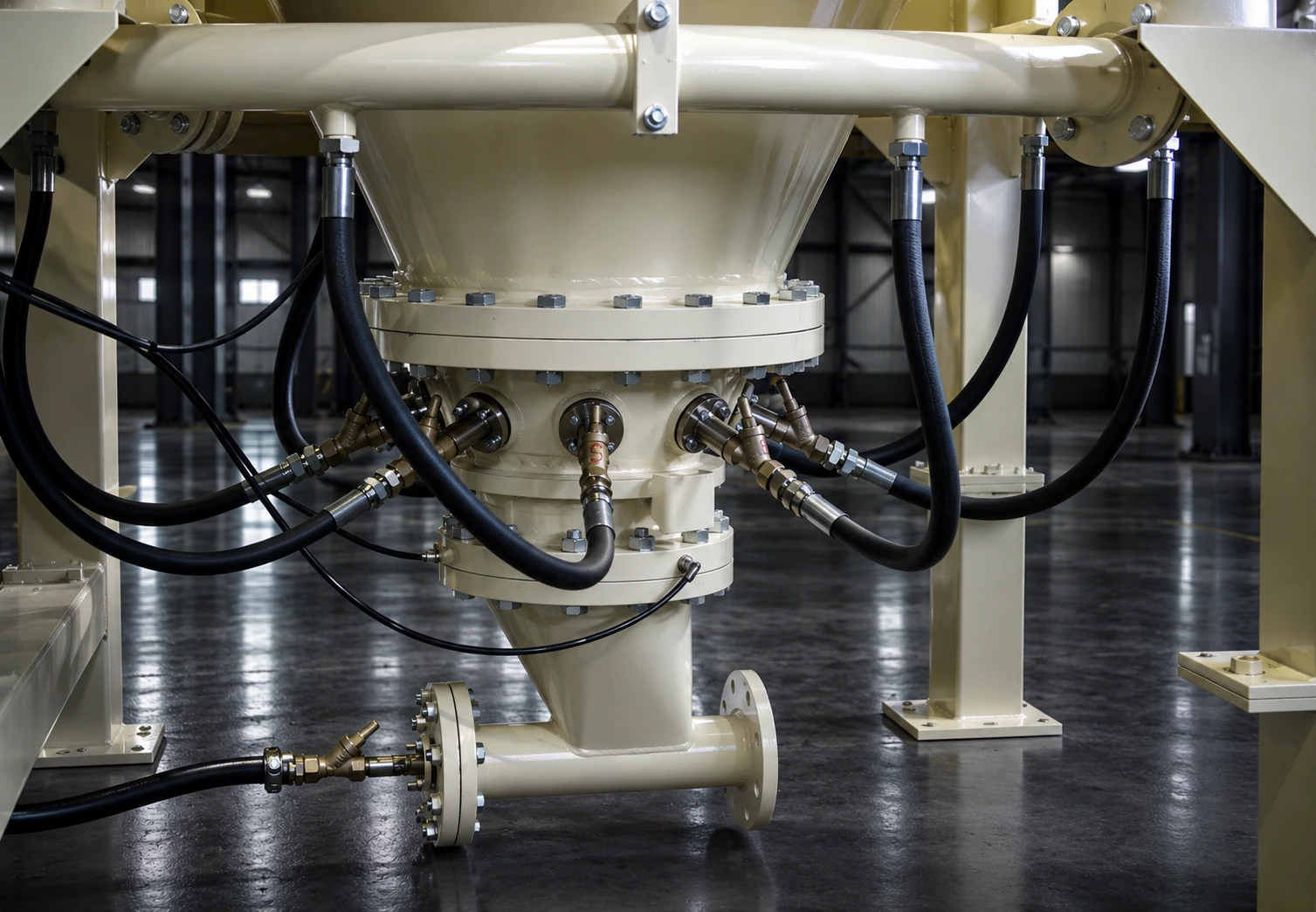
Compressed gas from the ring-shaped distribution pipe is injected into the product in pulses of 1–10 seconds. The gas expands to sonic speed at the nozzles and drives the whole batch in a circulation pattern — rising at the outer wall, descending in the centre. 2–10 pulses are usually enough for a homogeneous mix. Net volumes range from 1 to 100 m³; combined mixing-and-conveying stations reach up to 2,000 tons per day, with energy consumption as low as 0.2–1 kWh per ton of powder. The process develops no heat, causes minimal abrasion, preserves fragile granules and rules out contamination from gasket wear or lubricants.
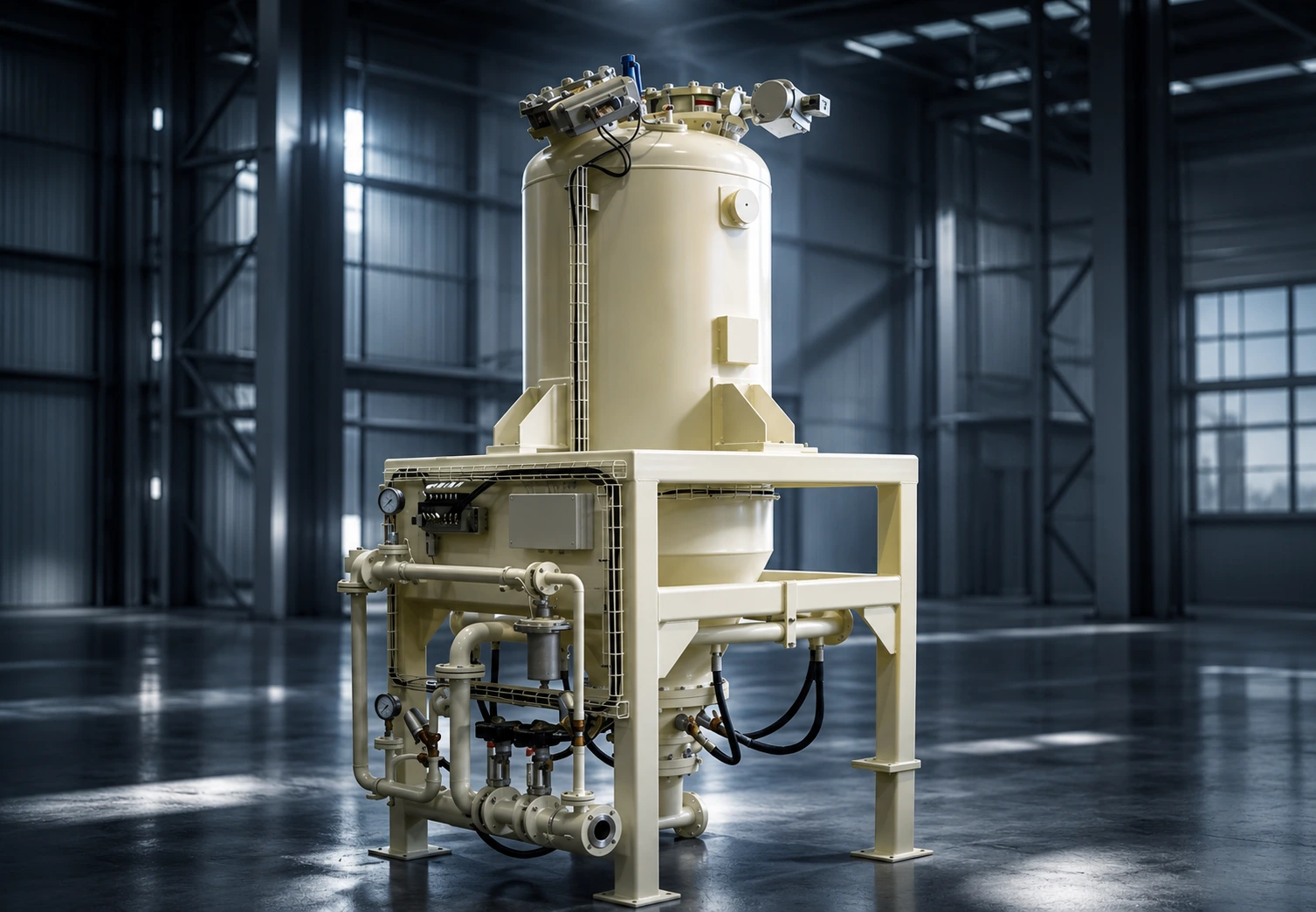
Suitable: free-flowing powders and granules, including chemicals, food-grade ingredients, building materials, plastics pellets, mineral powders, and fertilisers — provided the material is not excessively cohesive or sticky.
Not suitable: highly cohesive pastes or slurries (requires a mechanical mixer); materials requiring shear-intensive blending (for example, dispersion of nano-particles into a liquid).
The mixer uses precisely metered air pulses to gently fluidise the powder bed; there are no blade surfaces to impact granules. Practical tests show breakage rates for products such as washing-powder granules and urea fertiliser are typically below 0.3%. In terms of mixing quality, a relative standard deviation (RSD) of ≤ 5% is readily achievable.
Mixing time depends on the material and vessel volume. For most free-flowing powders in a 20–50 m³ vessel, the batch is fully homogenised in 30–120 seconds. For difficult cohesive materials or larger vessels, 3–5 minutes is typical. BONAFEI systems range in capacity from 1 m³ to 100 m³.
Yes. Because there are no mechanical moving parts inside the vessel, there is no mechanical ignition source. When the air supply system (valves, piping) is ATEX-certified and the vessel is grounded/earthed, the system meets ATEX Zone 21 requirements for combustible-dust atmospheres. Please specify ATEX requirements at the enquiry stage so that the appropriate components are selected.
Air consumption depends on vessel volume, material bulk density, and required mixing intensity. As a guideline, a 20 m³ vessel processing granular material consumes approximately 8–15 Nm³ of compressed air per batch at 0.4–0.6 MPa. Overall energy consumption is approximately 0.2 kWh per tonne, which is typically 80–95% lower than equivalent ribbon blender installations.
There are no gearboxes, shafts, or bearings to lubricate — maintenance time is approximately 90% less than for mechanical mixers.
Yes. Many customers retrofit their existing silos. The key requirements are: ① the vessel must be capable of withstanding the operating pressure (typically 0.6 MPa); ② a suitable nozzle arrangement must be achievable — BONAFEI engineers assess the existing silo geometry and propose a nozzle layout; ③ the existing discharge cone angle and spout size should be reviewed for compatibility. BONAFEI provides complete feasibility assessment and retrofit engineering services.
Send us your product data — we reply within 24 hours on business days.
Contact Us微信 / WhatsApp:+86 186 5071 2596

 中文
中文  English
  Deutsch
  Français
  Español
  Português
  Русский
  العربية
  Tiếng Việt
  Bahasa Indonesia