
In industrial buildings, power, pipelines and heavy equipment, thermal expansion and stress release are unavoidable. PTFE sliding bearings are the industry-standard solution that lets these structures slide freely instead of cracking. Yet to save a little upfront budget, many buyers choose the simply made “bonded PTFE bearing” — and in demanding heavy-industry conditions that low-price choice often ends in a very costly maintenance disaster. Drawing on 30+ years of know-how from PG Systemtechnik of Germany, here is why embedded (anti-loss slot) PTFE sliding bearings must replace bonded ones in severe service.
1. Two “tight collars” of heavy-industry service: ultra-high pressure and severe temperature swings
- Very high local compressive stress: at large pipeline nodes, steel flue-gas towers (FGD) or heavy boiler supports, bearings carry extreme static and dynamic loads for long periods.
- Extreme ambient and medium temperature differences: from tens of degrees below zero outdoors in winter to hundreds of degrees conducted from hot pipelines.
Why bonded fails: physical and chemical breakdown
- Physical shear tearing: PTFE’s thermal-expansion coefficient is about 10× that of stainless steel and nearly 20× that of carbon steel. Under sharp temperature changes, enormous internal shear stress builds between PTFE and steel plate and rips the glue layer apart.
- Load-limit collapse: bonded PTFE’s ultimate surface compressive stress is only 5–10 N/mm². Overloaded, the thin PTFE film not only debonds but is squeezed out of shape and ruined.
The embedded answer: an anti-loss slot locks the material in place
PG Systemtechnik’s embedded bearings (e.g. the PGslide® series) change the load logic entirely. A PTFE plate at least 5 mm thick is set without damage into a precise ~3 mm slot in the steel base. Under heavy longitudinal pressure the PTFE, “chambered” by the rigid steel slot on all sides, cannot flow or extrude — so its ultimate surface compressive stress climbs effortlessly to 60 N/mm², a 6–12× jump in load capacity.
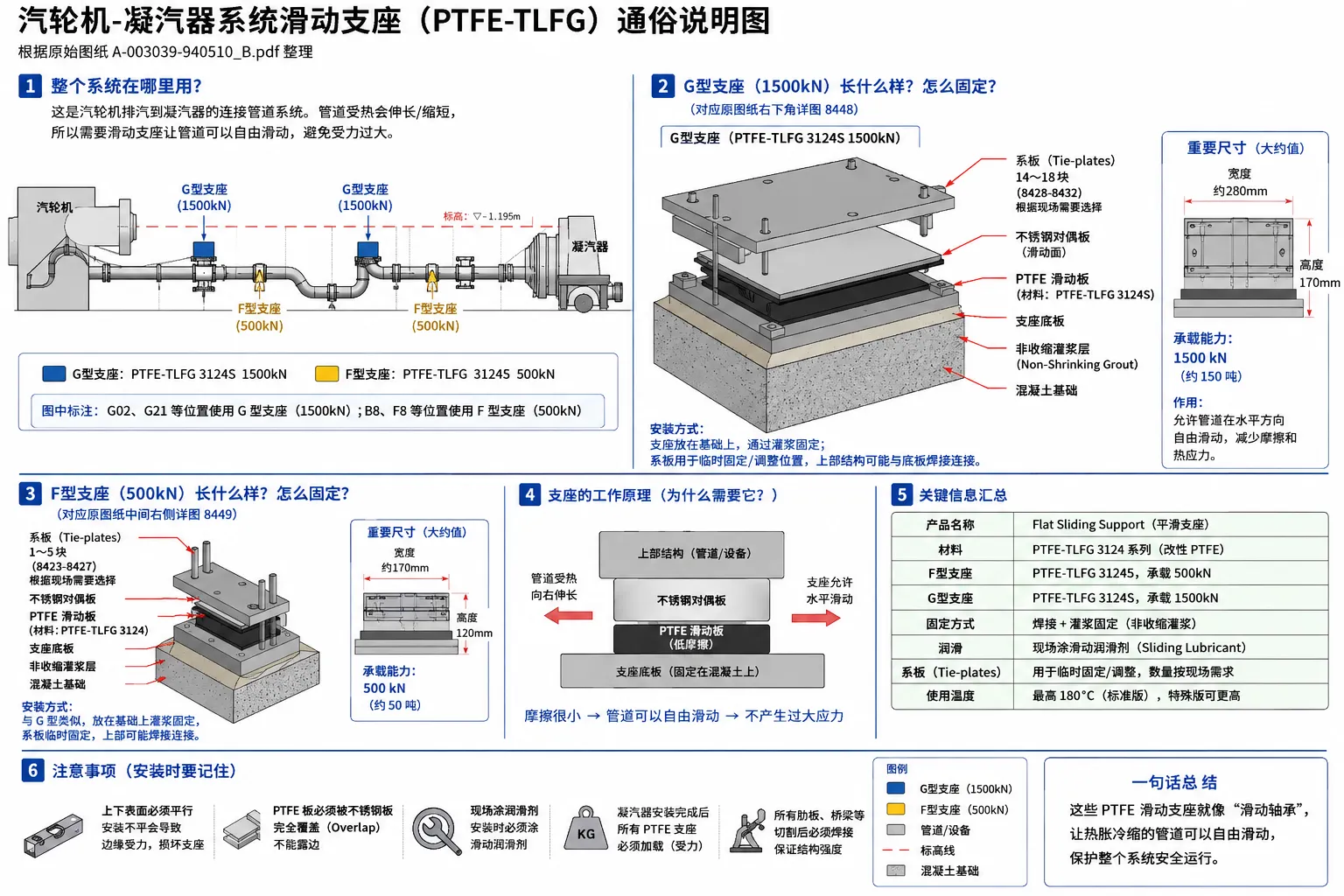
2. Core application scenarios
With this hardcore engineering, embedded PTFE sliding bearings prove irreplaceable in: large chemical and power plants (flue-gas desulfurization/FGD and thermal pipeline systems); heavy pipe racks and supports with large displacement; and any high-load, large-movement, harsh-environment project where bonded bearings would debond and fail.
Conclusion
For high-load, large-displacement, harsh service, the embedded-slot PTFE bearing is the only reliable choice — turning a recurring maintenance liability into decades of trouble-free sliding.