

PTT (Polytrimethylene Terephthalate) is a new-generation thermoplastic polyester synthesized from 1,3-propanediol (PDO) and purified terephthalic acid (PTA) via polycondensation. Its outstanding elastic recovery, low modulus, and excellent dyeability make PTT fibers widely used in textiles, carpets, and engineering plastics.
However, PTT polymerization is considerably more complex than PET. During the polycondensation stage, frequent side reactions generate large quantities of oligomers — particularly dipropylene glycol derivatives from PDO etherification and volatile cyclic dimers. These oligomers escape the reactor as vapor and rapidly solidify on any cooler pipe or equipment surface, causing blockages that critically threaten continuous plant operation.
The Scraper Condenser: Oligomer Interceptor
The scraper condenser is a critical component of the PTT polymerization vacuum system. Its vapor inlet connects directly to the polycondensation reactor vent, directing oligomer-laden hot gas into the condensation zone. Mechanical scrapers continuously clear wall deposits, preventing oligomers from accumulating at the thermally shocked discharge outlet and keeping the vacuum system open for uninterrupted production.
The discharge outlet of the scraper condenser is one of the most vulnerable points in the entire system — solidified oligomers dislodged by the scrapers fall into the outlet, which demands a valve that can reliably isolate the discharge path without being seized by viscous solid material.
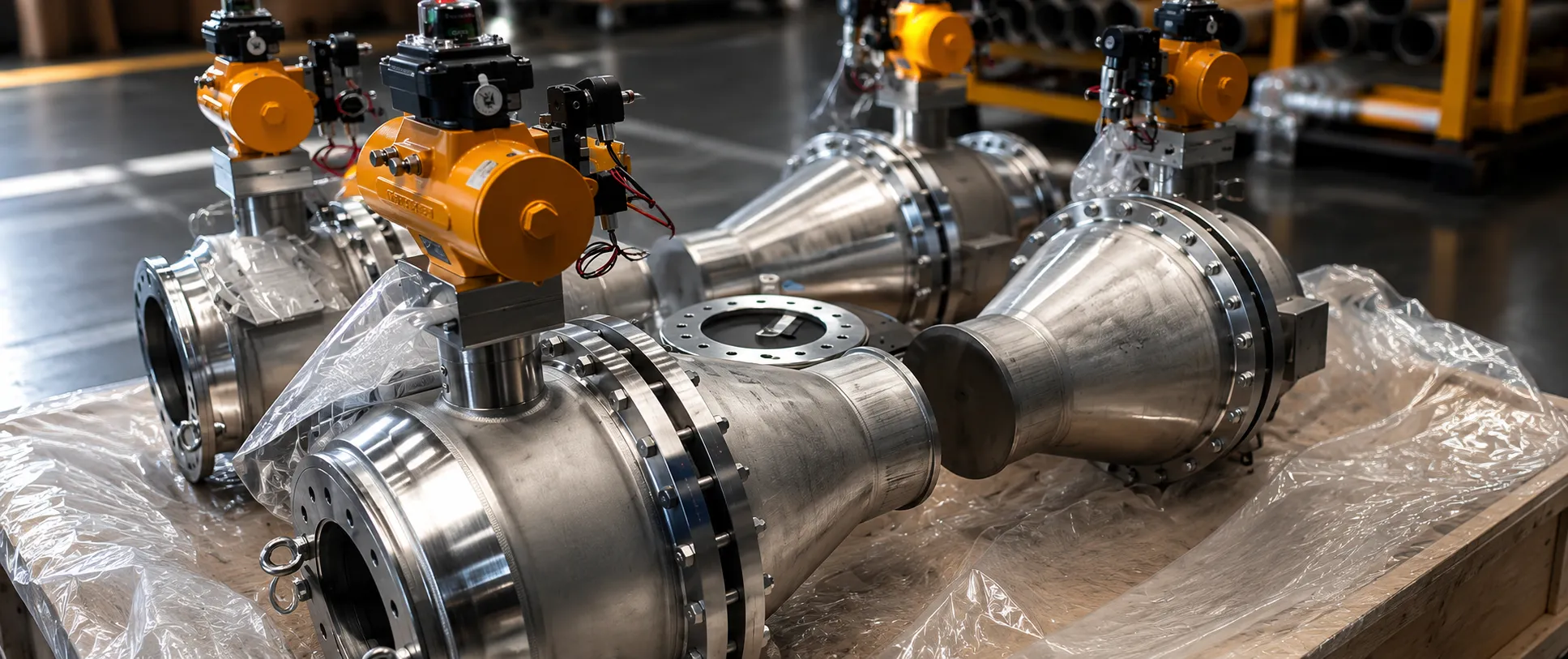
A Gate Valve Engineered for the Scraper Condenser
Conventional industrial butterfly and ball valves are virtually unusable in this service: oligomers accumulate and encapsulate the disc or ball, preventing normal rotation and causing valve failure. To solve this problem, Seco Anlagentechnik GmbH developed a purpose-designed spherical-cap gate valve, available in the CB50/CB60 series (DN250, DN300, DN350). The design has been successfully commissioned on multiple PTT polymerization trains worldwide.
Core Design Philosophy
Seco Anlagentechnik GmbH engineered the valve geometry specifically to allow solid particles to pass through the seating surface without forming a wedge-lock condition — eliminating the root cause of valve seizure by sticky solids.
Key Design Features
Pneumatic Rotary Actuator Drive
The valve is coupled to a pneumatic rotary actuator via a coupling, with maximum supply pressure of 8 bar. A 5/2 double-solenoid valve (120 V / 60 Hz) enables full PLC/DCS remote control. The coupling slot and position indicator provide unambiguous status: horizontal = CLOSED, vertical = OPEN.
Explosion-Proof Rating for Chemical Plant Environments
The solenoid valve is rated CL I, DIV 1, GR A/B/C/D and CL II, DIV 1, GR E/F/G. The limit switches are E Ex ia intrinsically safe, 24 V AC, meeting the explosion-proof requirements of PTT polymerization environments where organic solvent vapors may be present.
Material: 304 Stainless Steel (1.4301)
All wetted components are manufactured from 304 stainless steel (1.4301), rated to 200 °C continuous service temperature, compatible with PTT oligomer chemistry, and easy to clean.
Operating Principle
On receipt of an open or close command from the field panel or PLC/DCS, the solenoid valve ports air to or from the actuator, rotating the drive shaft 90° and moving the spherical cap to the open or closed position. Limit switches provide real-time position feedback to the control system, completing the closed-loop control loop.
Actuation speed is adjustable via the choke valves on the actuator to prevent mechanical damage from high-speed end-of-stroke impacts. During commissioning, always open the air supply gradually and increase speed incrementally.
Installation and Maintenance
Installation
- Mount the gate valve to the scraper condenser using socket-head cap screws
- Connect to the condenser and downstream piping using weld lip seals; perform leak testing after welding
- Install an isolation valve upstream of the control air supply to allow safe maintenance
- Always perform a functional test before welding the downstream piping
Commissioning
- Open the control air supply slowly to avoid pressure surge
- Cycle the solenoid valve manually several times to verify correct open/close operation
- Adjust the choke valves to achieve the desired actuation speed for the process
Routine Maintenance
- Regularly check the seal fluid level to confirm the shaft seal liquid barrier is effective
- Replace the drive shaft O-rings (part no. 34) at 1-year intervals
- Always refer to the spare-parts drawing when reassembling to ensure correct part placement
Engineering Value
In a PTT polymerization plant, failure of the scraper condenser discharge valve causes, at minimum, an unplanned shutdown and, at worst, complete solidification and blockage of the discharge system — a cleaning operation that can take days, with severe impact on on-stream rate and product quality.
The Seco Anlagentechnik GmbH spherical-cap gate valve achieves reliable operation through four design principles:
- Engineered for this specific duty — geometry designed around solid oligomer behavior, eliminating jamming at source
- Liquid-barrier shaft protection — proactive sealing, not reactive repair
- Pneumatic automation — eliminates manual intervention risk, handles high-cycle demands
- Full explosion-proof compliance — meets all chemical plant safety requirements
For engineers involved in the design and operation of PTT and PBT polyester polymerization plants, understanding and correctly selecting specialty process valves of this type is essential to maintaining long-term, stable plant operation.
Technical data sourced from Seco Anlagentechnik GmbH technical documentation and publicly available PTT polymerization process literature.